
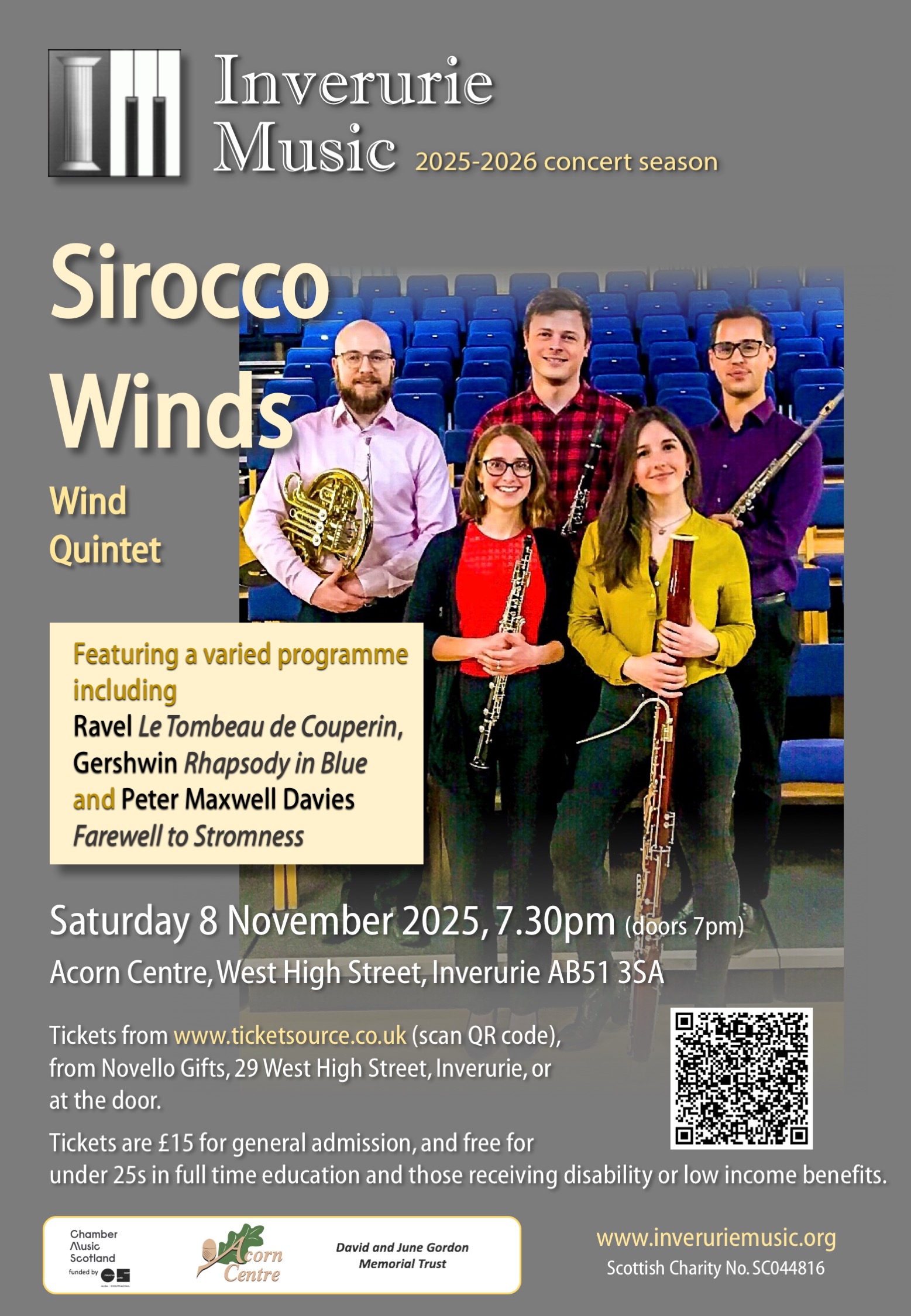
Following on from the pianistic pyrotechnics of Jonathan Mamora, it was time for something a bit lighter but no less technically assured – the second appearance in an Inverurie Music programme this calendar year of a wind quintet. A more playful cousin to the serious and sincere string quartet, the repertoire that has evolved along with the quintet is often lighter, brighter and quirkier than others, reflecting the five very different instruments that jostle together in this engaging ensemble. And it was wonderful to welcome such a fantastic exponent of this repertoire to Inverurie on a foggy autumn night, Sirocco Winds, fresh from navigating the choppy waters of island travel and safely ensconced in the warm acoustic of the Acorn Centre. They brought an exciting and varied programme that highlighted many of the different aspects of the wind quintet repertoire from characterful contemporary pieces to bespoke arrangements to romantic standards, all performed with poise, verve and humour.
The concert began in a stylish way with Ferenc Farkas’s Early Hungarian Dances, an arrangement made by the composer of earlier works in 1959. This beguiling set of pieces showed all the different characters of the wind quintet in fine fashion, finishing with a spirited dance that saw the music transcend its ‘provincial Hungarian Baroque style’ as the composer called it. If Farkas’s Early Hungarian Dances has been arranged by the composer for over seventeen different instrumental combinations, then there are very few arrangements of one of the staples of the twentieth-century piano repertoire, Ravel’s Tombeau de Couperin. But the Sirocco Winds turned in a performance that at times made the audience forget the French master’s pianism and listen to this wonderful music anew. Ravel arranged much of his piano music for orchestra, including this piece in 1919 (albeit without two of the movements), though it was still unusual to hear his music in such an unadorned manner. There was some beautiful playing throughout by the ensemble, the thinner textures leaving more space for the clarity of the instrumental lines. Tombeau de Couperin followed by Rhapsody in Blue is not an unusual combination in an orchestral concert but seeing it on a programme for wind quintet was perhaps a little more left field! The Gershwin was expertly introduced by the ensemble’s clarinettist, Calum Robertson (all the pieces were presented in an easy and knowledgeable fashion by the players), who explained in more detail the work’s famous clarinet introduction. It was a slightly disconcerting experience hearing this work, so famous and widely performed, in this stark way. Sometimes it felt like hearing a brand-new piece, sometimes like something half-heard and reminiscent. In either respect, the group gave a powerful performance, full of the energy and vigour this music demands.
The second half began with an equal amount of panache, Jim Parker’s Mississippi Five, the composer’s tribute to jazz greats from King Oliver to Bessie Smith. Parker’s work as a composer for television was never far from the surface, as the music was full of dramatic twists and turns, as well as adroitly proving a successful pastiche of a variety of jazz styles. The quintet obviously enjoyed the music greatly, as they gave a spirited performance across the five short movements. This was followed by two stately pieces of late-romantic chamber music: Amy Beach’s Pastorale and John Blackwood McEwen’s Under Northern Skies. Both found the quintet in more subdued demeanour, but no less expressive and assured in this music of great yearning and timelessness. The concert was finished with another arrangement, this time of Peter Maxwell Davies’s Orcadian rhapsody, Farewell to Stromness. This unprepossessing piano piece, part of a protest revue that Davies contributed to in 1980, was arranged with great feeling and empathy by the quintet’s flautist, Matthew Howells and provided a suitably apt way to end this very fine concert.
PAC